Your Swing Doesn’t Lie
Golf is one of the most technical sports out there, and most golfers know their swing better than they know their own body. You can probably tell when your hips are open too early or when you’re coming over the top. But here’s what a lot of golfers miss: your body will compensate for weakness or restriction long before it ever tells you something is wrong.
That means your swing can slowly change, not because your mechanics are off, but because your body is quietly working around a limitation. And by the time it shows up as pain, the compensation pattern has often been building for months.
Here are five signs worth paying attention to.
1. Your Swing Speed Has Dropped, But You Don’t Know Why
If you’ve lost distance despite no change in your fitness or technique, it’s worth asking whether your body is physically capable of generating the rotation it used to. A stiff thoracic spine or a hip that isn’t rotating fully can quietly rob you of power, long before it causes pain. Your brain is smart. If a movement isn’t available, it finds a way around it, usually by pulling force from somewhere else, which is rarely as efficient.
2. You Feel Tighter on One Side Than the Other

Golf is inherently asymmetrical, so some side-to-side difference is normal. But if you consistently feel restricted rotating one direction, or if one hip or shoulder feels noticeably tighter after a round, that’s not just “part of playing golf.” It’s often a sign that one side is doing more work than it should, which puts extra stress on the joints and tissues around it.
3. You’ve Changed Something in Your Setup Without Realizing It
Have you widened your stance? Shortened your backswing? Started standing a little more upright at address? These small, often unconscious adjustments are frequently your body’s way of avoiding a position that doesn’t feel stable or doesn’t have full mobility available. If your setup has drifted from what it used to be, that’s worth a closer look.
4. Soreness Shows Up in a Different Spot Each Season
If your “bad shoulder” turned into a “bad elbow,” and now it’s your low back that’s talking to you, that’s a pattern, not bad luck. When one area of the body isn’t functioning well, the joints around it often pick up the extra load until they eventually get overwhelmed too. Chasing the new sore spot without addressing the original limitation is how this cycle repeats itself year after year.
View this post on Instagram
5. You Feel Fine Warming Up, But Something Changes by the Back Nine
This one is common and easy to dismiss. If you feel great on the range and through the first several holes, but something starts to tighten up or ache as the round goes on, that’s often a sign of a stability or endurance limitation, not just fatigue. Your body can compensate well for a short period of time. The question is what happens once that compensation has to hold up for four hours.
Why This Matters More Than You’d Think
None of these signs mean something is seriously wrong. But they are all signals, and signals are worth listening to before they turn into pain that actually takes you off the course.
The problem with waiting is that compensation patterns don’t correct themselves. They tend to get more ingrained the longer they’re allowed to run the show, which means the swing changes become harder to undo and the eventual injury takes longer to resolve. The good news: identifying these patterns early is usually a quick process, and addressing them rarely means stepping away from the game you love. It usually means restoring the mobility, stability, or strength that’s missing, so your body doesn’t have to compensate in the first place.
If you want to read our other blog posts, click HERE to visit the Blog Page.
Finally, if you already feel like you have enough information and you’re ready to get help from providers that take the time and attention you deserve, then click HERE to request a $35 Discovery Visit with one of our expert physical therapists.
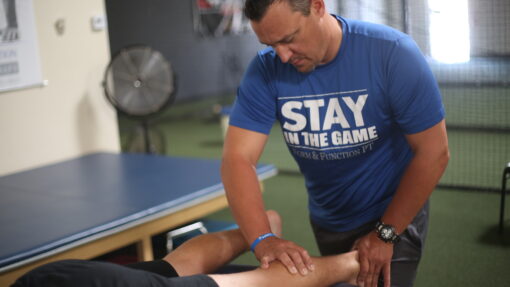
Elevate Your Healing Journey with PEMF Therapy at Form & Function PT
If you’re navigating the path to recovery or striving for enhanced well-being, PEMF therapy might be the transformative solution you need. At Form & Function PT, we’re dedicated to guiding you through each step of your health journey with our expert therapies, including the groundbreaking PEMF treatment. Ready to explore how PEMF therapy can benefit you? Reach out to us at (888) 619-2885 for a conversation with our physical therapists and discover a new avenue to health and vitality.
If You Liked This Article, You Might Like…
From Warm-Up to Wind-Down: Level Up Your Court Routine! Swing Like a Pro: 3 Game-Changing Exercises to Drive Your Golf Performance