
The Pattern You Already Know Too Well
If you’ve dealt with lower back pain or sciatica more than once, you already know the pattern. It flares up, you back off activity, it eventually settles down, and life goes back to normal. Then weeks or months later, it’s back. Bending to grab something off the floor, sitting through a long meeting, getting out of bed on a Monday morning, and there it is again.
This cycle is incredibly common, and if you’ve been living inside it for a while, you’ve probably been told a few things along the way: it’s just part of getting older, you probably have some “wear and tear,” or you just need to rest it and let it calm down.
Here’s the problem: none of that actually explains why it keeps happening. And if the explanation doesn’t hold up, the advice that comes with it probably won’t fix the problem either.
The Myth of “Just Rest It”
Resting a flared-up back feels like the obvious move. It hurts, so you stop doing the thing that hurts. But prolonged rest is often exactly what keeps this cycle going.
Your spine is built for movement. Spinal disks rely on motion to stay hydrated, almost like a sponge that needs to be squeezed and released to draw in fluid. The muscles surrounding your spine need regular activation to actually support it. When you rest for too long, you’re not giving your back a chance to heal. You’re allowing the muscles that should be protecting your spine to get weaker, stiffer, and less capable of doing their job.
There’s also a mental shift that happens during extended rest. Once you’re told to protect your back, movement starts to feel risky. Bending feels scary. Lifting feels dangerous. And the less you move, the more guarded your body becomes, which often increases sensitivity rather than reducing it.
Short-term rest during an acute flare-up has its place. But long-term avoidance of movement is one of the most common reasons lower back pain becomes a recurring problem instead of a one-time event.
What’s Actually Happening When Sciatica Flares Up
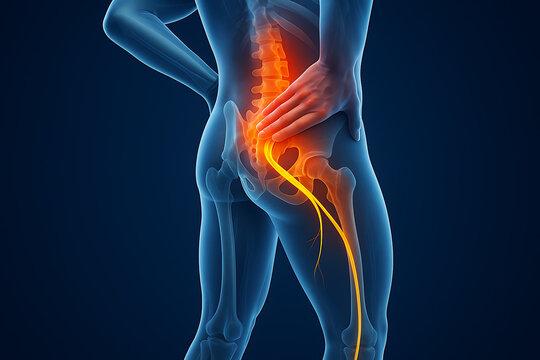
Sciatica isn’t its own condition. It’s a symptom. It occurs when the sciatic nerve, which runs from your lower back through your hip and down your leg, becomes irritated or compressed somewhere along its path. This irritation typically comes from tight or overactive muscles pressing on the nerve, a slightly bulging disk creating localized pressure, or stiff joints in the lower spine that aren’t moving through their full range.
In most cases, this irritation is not a sign that something in your back is structurally broken. It’s a sign that something around the nerve, whether that’s muscle imbalance, joint stiffness, or a movement pattern that’s putting uneven stress on the area, isn’t functioning the way it should.
Think of it like a smoke alarm. The pain is the alarm going off. The real question isn’t how to silence the alarm. It’s what’s actually causing the smoke.
For some people, that’s a hip that doesn’t rotate well, forcing the lower back to compensate with every step. For others, it’s weak glute muscles that leave the lower back picking up the slack during walking, standing, or climbing stairs. For others, it’s years of sitting that left certain muscles tight and others essentially switched off.
This is also why imaging often doesn’t tell the full story. Many people get an MRI or X-ray, are told they have “some wear and tear consistent with their age,” and leave more confused than when they arrived, because that explanation doesn’t match the intensity or suddenness of what they’re feeling.
Why the Pain Keeps Returning
If the underlying cause was never addressed, the conditions that triggered the original flare-up are usually still present, even after the pain quiets down. Weak stabilizing muscles, stiff joints, and poor movement patterns don’t resolve themselves just because symptoms have settled.
The nerve irritation calms down, but the mechanical issue causing it doesn’t disappear. It sits quietly until the next trigger, whether that’s a long car ride, an awkward lift, or a rough night’s sleep, sets it off again.
Rest, ice, heat, and pain relief can all help you get through a flare-up more comfortably. But none of them are designed to correct the actual muscular or movement-based issue causing the irritation in the first place. Unplugging a smoke alarm doesn’t solve a problem in the kitchen. It just means you won’t hear about it next time.
This is also why lower back pain often feels unpredictable. It can feel completely fine for weeks, then get triggered by something as minor as picking up a grocery bag or sneezing at the wrong angle. That unpredictability usually isn’t random. It’s typically a sign that an underlying issue has been building quietly in the background the entire time.
View this post on Instagram
A Simple Self-Check You Can Try
Here’s a low-risk way to start building awareness of how your body is moving.
Stand with your feet hip-width apart and slowly hinge forward at your hips, like a gentle forward bend, keeping your knees soft. Notice whether one side of your lower back feels tighter or more restricted than the other, and whether the movement feels smooth or like your lower back is doing all the work while your hips stay stiff.
You can also try standing on one leg for a few seconds, then switching sides. Notice if one side feels noticeably less stable than the other.
This isn’t a diagnostic tool, and you shouldn’t push through pain to complete it. It’s simply a way to start noticing asymmetries or restrictions that might be contributing to the pattern you’ve been experiencing.
 Breaking the Cycle for Good
 Breaking the Cycle for Good
Recurring lower back pain and sciatica are common, and in most cases, they respond very well to the right approach. That approach isn’t more rest, and it isn’t simply managing symptoms every time they show up. It’s identifying the specific movement dysfunction, muscle imbalance, or joint restriction that’s creating the irritation in the first place, and correcting it directly.
This is where a proper physical therapy evaluation makes the difference between temporary relief and lasting change. Rather than treating the flare-up in isolation, a thorough assessment looks at how your entire body moves, where compensation patterns have developed, and why your nervous system keeps flagging that specific area as a problem. From there, a targeted plan combining hands-on treatment and strength-based rehab can address the root cause instead of just quieting the alarm.
You don’t have to accept recurring back pain as an inevitable part of getting older or staying active. It’s not about finding a magic stretch or waiting for a good day. It’s about understanding your body’s specific pattern and giving it what it actually needs to stop setting off the alarm.
Ready to Get to the Root of It?
If this cycle sounds familiar, you don’t have to keep guessing what’s causing it or waiting for the next flare-up to disrupt your routine. A thorough evaluation can identify exactly what’s driving your symptoms and give you a clear path forward, one that’s built around your body, not a generic protocol.
If you want to read our other blog posts, click HERE to visit the Blog Page.
Finally, if you already feel like you have enough information and you’re ready to get help from providers that take the time and attention you deserve, then click HERE to request a $35 Discovery Visit with one of our expert physical therapists.

Elevate Your Healing Journey with PEMF Therapy at Form & Function PT
If you’re navigating the path to recovery or striving for enhanced well-being, PEMF therapy might be the transformative solution you need. At Form & Function PT, we’re dedicated to guiding you through each step of your health journey with our expert therapies, including the groundbreaking PEMF treatment. Ready to explore how PEMF therapy can benefit you? Reach out to us at (888) 619-2885 for a conversation with our physical therapists and discover a new avenue to health and vitality.
5 Warning Signs Your Golf Swing Is Compensating for an Old Injury From Warm-Up to Wind-Down: Level Up Your Court Routine!